Few places in Africa offer the opportunity to experience breathtaking mountain landscapes while immersing yourself in a living culture that has evolved alongside nature for centuries. Hidden on the slopes of the legendary Rwenzori Mountains, the Bakonzo people invite travelers into a world where mountains are sacred, traditions remain alive, and every path tells a story.
For visitors seeking meaningful travel, authentic cultural encounters, and unforgettable landscapes, meeting the Bakonzo is one of Uganda's most rewarding experiences.
Who are the Bakonzo?
The Bakonzo (singular: Mukonzo) are an indigenous Bantu-speaking people who have lived on both sides of the Rwenzori Mountains for generations. Today, they are found mainly in western Uganda, particularly in Kasese and Bundibugyo districts, and across the border in the eastern Democratic Republic of Congo, where closely related communities are often known as the Banande or Nande.
The international border that separates Uganda and the Democratic Republic of Congo is relatively recent in history. Long before it existed, the Bakonzo and Banande lived as one mountain people, sharing language, traditions, trade routes, and family ties. Even today, many families have relatives on both sides of the Rwenzori Mountains.
The language spoken in Uganda is Lukonzo, while in eastern Congo it is commonly called Kinande or Lunande. Although there are differences in pronunciation and vocabulary, speakers easily understand one another, reflecting their shared heritage.
A Culture Shaped by the Mountains
The Rwenzori Mountains—often called the "Mountains of the Moon"—are far more than a dramatic backdrop. They have shaped every aspect of Bakonzo life.
For centuries, the steep valleys, fast-flowing rivers, fertile volcanic soils, forests, and changing climates influenced how people farmed, built their homes, prepared food, worshipped, and celebrated important milestones.
Living in one of Africa’s most spectacular mountain landscapes has helped shape a culture unlike any other in Uganda. Many have noted minor similarities between the Bakonzo dialect and cultural practices and those of the Bagisu, another mountain people living on the slopes of Mount Elgon in eastern Uganda. Yet Mount Elgon lies roughly 600 kilometres from the Rwenzoris, with more than ten distinct ethnic groups inhabiting the lands between the two mountain ranges.
The presence of these similarities across such a vast geographical and cultural distance suggests something deeper: that the Bakonzo identity is not simply a product of the people who inhabit the Rwenzoris, but of the mountains themselves. In many ways, Bakonzo culture appears to have been forged by the unique environment of the Rwenzoris—its isolation, landscape, and centuries of life among the peaks. The mountains are not merely the backdrop to Bakonzo culture; they are, in a very real sense, its birthplace.
Mountain farming, forest knowledge, herbal medicine, storytelling, music, and traditional craftsmanship all reflect a deep relationship between the people and their environment. Visitors quickly discover that nature and culture are inseparable in Bakonzo life.
Experience Authentic Bakonzo Culture in Ruboni Tourism Village
Nestled at the gateway to Rwenzori Mountains National Park, Ruboni Tourism Village offers one of Uganda's richest community tourism experiences.
Rather than simply observing culture, visitors are welcomed to become part of daily village life. Local families share their homes, knowledge, stories, and traditions, allowing guests to experience authentic cultural practices that have been passed from one generation to the next.
Depending on your interests and available time, experiences can range from a few hours to several days.
Traditional Food Experiences
Food is one of the best ways to understand Bakonzo culture.
Visitors can join local women and elders to prepare traditional meals using ingredients grown on the mountain slopes.
Some local specialties include:
- Obundu – a nutritious millet porridge enjoyed by many families.
- Sombe – tender cassava leaves cooked with groundnuts or sesame.
- Eritene – a cherished traditional dish prepared during family gatherings.
- Ferinda – a local delicacy with deep cultural significance.
- Ebwanga – a traditional sauce accompanying staple foods.
- Ebiserere – seasonal vegetables harvested from village gardens.
Guests are encouraged to help prepare the meals before sharing them with local families. From this website, you can already contact us to book your spot on this experience.
Learn Traditional Farming Practices
The fertile soils surrounding the Rwenzori Mountains have supported farming for generations.
Join farmers as they:
- Grind millet using traditional stones.
- Harvest bananas and cassava.
- Visit coffee gardens.
- Learn about mountain agriculture.
- Discover indigenous vegetables and medicinal plants.
These experiences demonstrate how communities have sustainably used mountain landscapes for centuries.
Traditional Brewing
The Bakonzo have developed several traditional beverages that remain important during ceremonies, celebrations, and community gatherings.
Visitors may observe or participate in:
- Traditional Tonto (banana beer) brewing.
- Banana wine making.
- Traditional gin distillation using local techniques.
- Banana Juice making
Every drink has its own story, customs, and role in community life.
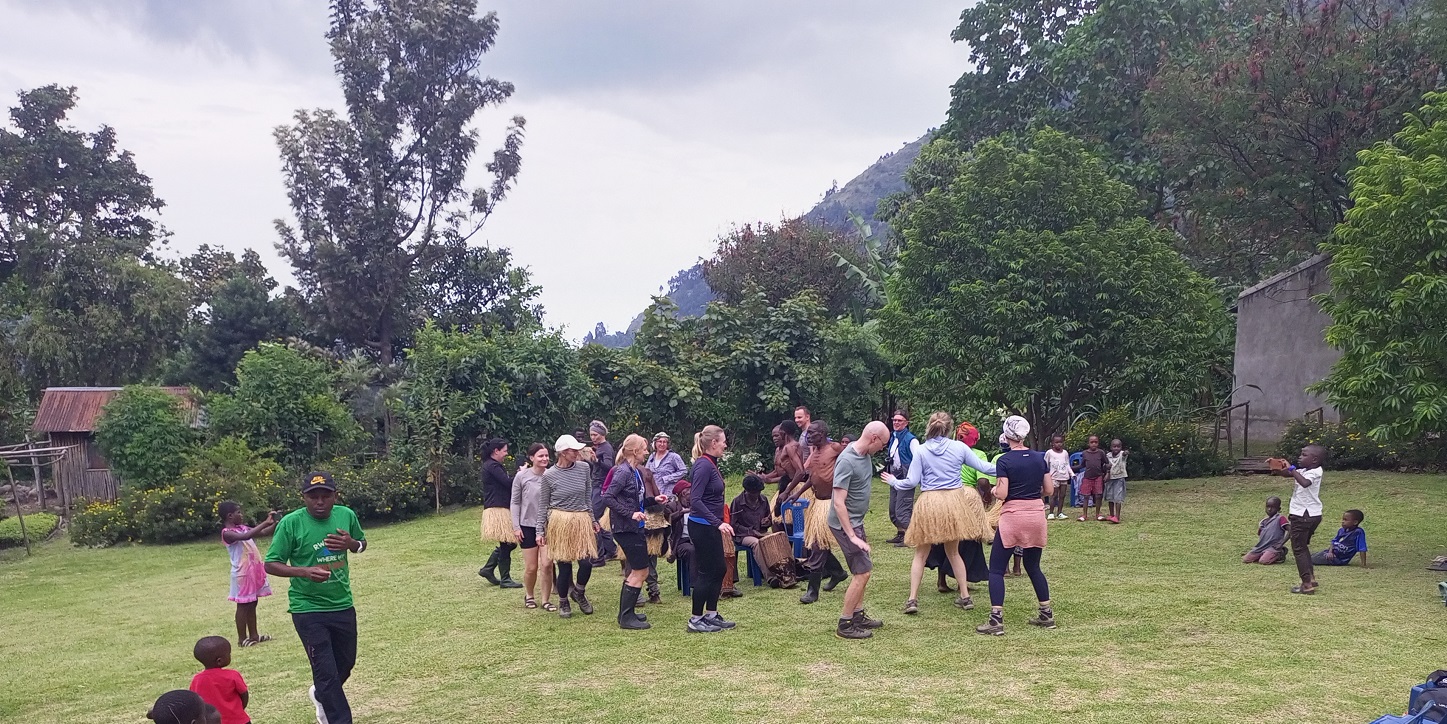
Music, Dance and Storytelling
No visit is complete without experiencing Bakonzo music and dance.
Energetic drum rhythms, songs, and dances celebrate harvests, weddings, community achievements, and important cultural events. Local performers also explain the meaning behind different dances and the stories carried through generations.
Many visitors find these performances among the highlights of their journey through western Uganda.
Traditional Crafts and Daily Life
Guests can also participate in hands-on activities such as:
- Traditional skin tanning techniques.
- Basket weaving.
- Cooking with local families.
- Firewood collection.
- Household activities.
- Traditional architecture.
- Storytelling and educative cultural songs around evening fires.
These activities provide a genuine understanding of everyday life in the mountain communities.
Culture and Spiritual Beliefs
Traditionally, the Bakonzo viewed the Rwenzori Mountains as a sacred place. Many beliefs centered on respect for nature, ancestors, rivers, forests, and mountain spirits. While Christianity is now the predominant religion among the Bakonzo, many cultural traditions and values continue to reflect this long-standing spiritual connection with the mountains.
Respect for elders, hospitality, cooperation, and stewardship of the natural environment remain important values within many communities today.
Circumcision and Cultural Identity
Like several mountain communities in East Africa, some Bakonzo families continue to practice traditional male circumcision as an important rite of passage into adulthood. Although practices have evolved over time and vary between communities, the ceremony remains an important expression of cultural identity for many families. This event holds a big identity in the musing, songsa and dance by the Bakonzo community as they share the story of how circumcision was celebrated.
A Living Culture, Not a Museum
What makes visiting Ruboni different is that visitors experience a living community rather than staged performances.
The people you meet are farmers, guides, artisans, musicians, conservationists, and entrepreneurs who proudly share their heritage while protecting the landscapes that support their livelihoods.
During the visit, guests have an opportunity to book a spot to attend the community own cultural events that are used to transfer traditional skills and knowledge between generations. Community tourism has become an important way of preserving Bakonzo traditions while creating income that supports families, education, conservation, and sustainable development.
Discover Uganda Through Its People
Many travelers visit Uganda to see gorillas, chimpanzees, tree-climbing lions, or the snow-capped peaks of the Rwenzori Mountains. Yet some of the country's greatest treasures are its people.
Meeting the Bakonzo offers something that cannot be photographed from a safari vehicle—a genuine human connection.
Whether you join a family to prepare a traditional meal, learn to brew banana beer, dance to mountain rhythms, walk through coffee gardens, forests, or listen to stories beneath the towering Rwenzori peaks, you leave with more than memories. You leave with friendships and a deeper appreciation of one of East Africa's most remarkable mountain cultures.
Ruboni Tourism Village offers cultural experiences ranging from a two-hour village visit to immersive three-day cultural packages, including the renowned Bakonzo Cultural Food Experience, guided village walks, traditional cooking, music and dance, farming activities, storytelling, and opportunities to meet or stay with the local families.
If you're searching for an authentic cultural adventure near Rwenzori Mountains National Park or as an extension to a safari in Queen Elizabeth National Park, Ruboni Tourism Village is one of Uganda's finest destinations for community-based tourism, where culture, conservation, and nature come together in one unforgettable experience.