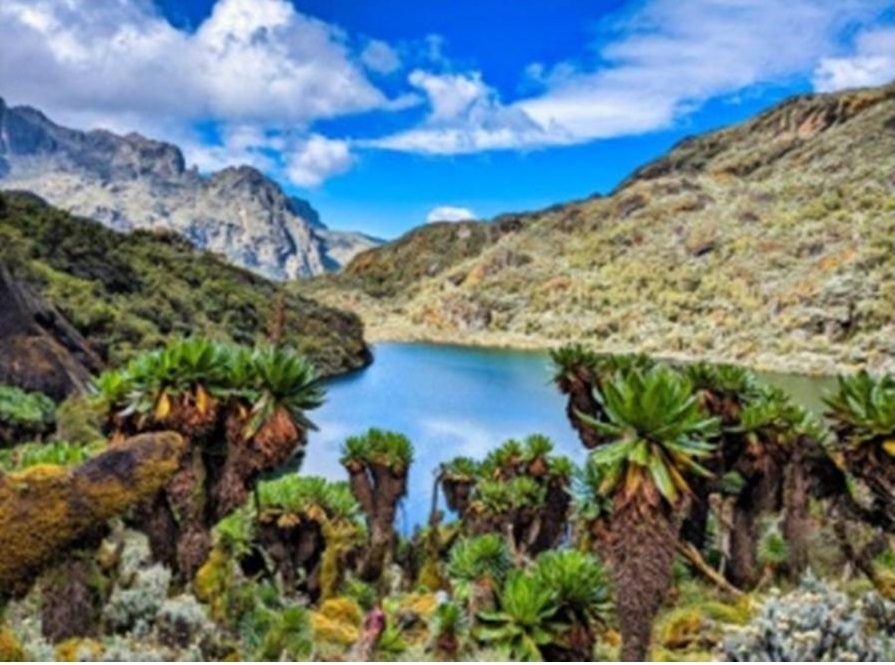
"Every mountain has a story, but few mountains have inspired as much mystery, scientific curiosity and adventure as the Rwenzori Mountains."
Introduction
The story of the Rwenzori Mountains is much older than maps, explorers or national parks. For thousands of years, these mountains have been the homeland of the Bakonzo people, who have lived along their slopes, cultivated their fertile valleys and regarded the snow-covered peaks as sacred places inhabited by powerful ancestral spirits. Long before European explorers reached the region, the Bakonzo possessed an intimate understanding of the mountain's rivers, forests, weather, wildlife and alpine zones.
Today, the Rwenzori Mountains National Park is internationally recognised for world-class trekking, scientific research and biodiversity conservation. Yet its tourism history is the result of centuries of exploration, changing conservation policies and strong partnerships between government, private operators and local communities.
The Mountains Before Modern Exploration
The Bakonzo, together with neighbouring Bamba communities, have occupied the eastern slopes of the Rwenzori for generations. Across the present-day border in the Democratic Republic of Congo, related communities, including the Banande, have similarly depended on the mountains for their livelihoods.
To these communities, the Rwenzori were never "discovered." They were known simply as home.
The mountains provided:
- Fresh water from glaciers and rivers
- Fertile soils for farming
- Bamboo for construction
- Medicinal plants
- Wild fruits and mushrooms
- Honey
- Sacred sites for traditional rituals
- Grazing grounds in selected areas
- Hunting grounds before conservation laws were introduced
Many Bakonzo oral traditions refer to Kithasamba, the highest snowy mountain, which corresponds to today's Mount Stanley. The snow-covered summits were believed to be the dwelling place of Kitasamba, a supreme spiritual being associated with rain, fertility and protection.
These indigenous knowledge systems guided movement through the mountains long before formal trails existed.
The Ancient "Mountains of the Moon"
The mystery of the Rwenzori stretches back nearly two thousand years.
Around AD 150, the Greek geographer Claudius Ptolemy described snow-covered mountains near the Equator that supplied the River Nile. He called them the "Mountains of the Moon" (Lunae Montes).
Although historians continue to debate the precise location Ptolemy intended, many scholars believe his description most closely matches the Rwenzori Mountains because they are one of the few places in equatorial Africa where permanent snow feeds river systems flowing toward the Nile Basin.
For centuries, these mountains remained one of geography's greatest mysteries.
Henry Morton Stanley and the "Rediscovery" of the Rwenzori
European knowledge of the Rwenzori expanded dramatically during the nineteenth century.
On 24 May 1888, British-American explorer Sir Henry Morton Stanley observed the snow-covered mountains while travelling through the Kingdom of Tooro during his Emin Pasha Relief Expedition.
Stanley named them "Ruwenzori," adapting the local name into English spelling.
His reports astonished the scientific community because many Europeans considered it impossible for permanent snow to exist almost on the Equator.
Stanley's descriptions revived worldwide interest in the Mountains of the Moon and inspired future scientific expeditions.
However, it is important to recognise that Stanley did not "discover" the mountains. He introduced them to European geographical literature, while the Bakonzo and neighbouring communities had known and lived with them for centuries.
Scientific Exploration Begins
Following Stanley's reports, numerous scientific expeditions visited the Rwenzori during the late nineteenth century.
Researchers came to study:
- glaciers
- alpine vegetation
- geology
- rivers
- climate
- wildlife
- ethnography of the Bakonzo and Bamba peoples
These expeditions confirmed that the Rwenzori possessed one of Africa's most unusual mountain ecosystems, with giant lobelias, giant groundsels, alpine bogs and extensive glaciers.
The Duke of Abruzzi Expedition (1906)
The expedition that transformed the Rwenzori into an internationally recognised mountaineering destination was led by Prince Luigi Amedeo, Duke of Abruzzi, in 1906.
The Italian prince assembled one of the most accomplished mountaineering teams of the era, including experienced Alpine climbers, photographers, surveyors and scientists.
Between June and July 1906, the expedition successfully climbed many of the highest peaks for the first recorded time.
Among their achievements were first ascents of:
- Mount Stanley
- Mount Speke
- Mount Baker
- Mount Emin
- Mount Gessi
- Mount Luigi di Savoia
On 18 June 1906, members of the expedition reached Margherita Peak, the highest point in Uganda and the third-highest summit in Africa.
The Duke's expedition also:
- produced remarkably accurate maps
- photographed the glaciers
- documented alpine vegetation
- described climbing routes
- named many peaks after members of the Italian royal family
His monumental publication, The Ruwenzori, remains one of the most important historical references on the mountain.
Several sections of today's Central Circuit still follow terrain first explored during this expedition.
Early Mountaineering Tourism
Following the Duke's success, a small number of adventurous climbers began visiting the Rwenzori.
Travel was extremely difficult.
Visitors typically travelled by:
- steamship across Lake Victoria
- railway to western Uganda
- motor vehicle where roads existed
- horseback
- porters carrying equipment
- footpaths through mountain villages
Local Bakonzo men became indispensable guides and porters because of their exceptional knowledge of the mountain terrain.
Many of the guiding traditions still practised today trace their origins to this early period.
Tourism Before National Park Status
Throughout much of the twentieth century, the Rwenzori remained part of the Central Forest Reserve rather than a national park.
During this period:
- local communities farmed inside parts of the mountain
- livestock grazing occurred in some areas
- bamboo harvesting continued
- hunting persisted in selected locations
- medicinal plants were collected
- cultural sites remained accessible
- mountaineering occurred alongside everyday community activities
Tourism was relatively small in scale, with only a few adventurous climbers visiting each year.
Creation of Rwenzori Mountains National Park
Recognising the mountain's outstanding biodiversity and increasing conservation importance, the Government of Uganda gazetted Rwenzori Mountains National Park in 1991.
Management responsibility was assigned to the Uganda Wildlife Authority (UWA) following its establishment in 1996.
The creation of the national park fundamentally changed the relationship between people and the mountains.
Activities that became prohibited inside the protected area included:
- permanent settlement
- agriculture
- hunting
- commercial timber harvesting
- uncontrolled grazing
- mining
- unrestricted harvesting of forest products
Many Bakonzo households who had depended directly on mountain resources experienced significant livelihood changes. This prompted a new conservation approach that sought to balance biodiversity protection with community development.
Community Conservation
One of the defining features of conservation in the Rwenzori has been the gradual shift toward community participation.
Today, neighbouring communities benefit through:
- employment as guides
- porter services
- cooks and camp attendants
- accommodation businesses
- cultural tourism enterprises
- craft production
- transport services
- conservation education
- revenue sharing
- collaborative resource-use agreements in designated areas
Community-based organisations such as the Ruboni Community Conservation and Development Programme (RCCDP) have demonstrated how tourism can generate income while supporting conservation and improving local livelihoods.
Ruboni Tourism Village, located near the Central Circuit trailhead, has become one of Uganda's leading examples of community-based tourism and received international recognition as a UN Tourism Best Tourism Village in 2024.
The First Official Trekking Trail
Following the establishment of the national park, Uganda Wildlife Authority developed what became known as the Central Circuit Trail.
Entering through Nyakalengija, this route was designed to provide access to the major mountain massifs, alpine lakes and eventually Margherita Peak.
The Central Circuit became Uganda's flagship high-altitude trekking route and remains one of Africa's classic mountain expeditions.
Purpose-built mountain huts were constructed at strategic elevations to support multi-day expeditions, improving safety while reducing environmental impacts.
Growth of Professional Mountain Guiding
As tourism expanded, specialist organisations emerged to support mountain operations.
Among the best-known are:
- Rwenzori Mountaineering Services (RMS), established in the late 1980s and operating the Central Circuit under concession for many years.
- Rwenzori Trekking Services (RTS), which developed the Kilembe Trail and later expanded its trekking products.
- Rwenzori Hikers and Escorts Association (RHEA), representing trained local mountain guides, porters and support staff.
- Abanyarwenzori Mountaineering Association (AMA), contributing to guiding standards and community participation in mountain tourism.
These organisations have helped professionalise guiding, rescue procedures, porter welfare, equipment standards and visitor safety.
Expansion of the Trail Network
Although the Central Circuit remains the best-known route, tourism has diversified significantly.
Uganda Wildlife Authority has worked with concessionaires and neighbouring communities to develop additional trails that cater to different visitor interests.
Today, visitors can choose from:
- short forest nature walks
- waterfall hikes
- birding trails
- cultural trekking experiences
- overnight mountain adventures
- technical glacier expeditions
- summit climbs to Margherita Peak
Recent trail development has also improved access from different districts surrounding the park, creating wider economic opportunities for local communities.
Tourism Today
Rwenzori trekking has evolved from a small mountaineering pursuit into one of Uganda's premier adventure tourism experiences.
The mountain now attracts:
- international climbers
- university researchers
- conservation scientists
- birdwatchers
- photographers
- school groups
- cultural tourists
- professional mountaineers
- adventure travellers completing African mountain challenges
Tourism is supported by partnerships among the Uganda Wildlife Authority, licensed private operators, local governments, community organisations and national tourism institutions.
While visitor numbers remain lower than those of Mount Kilimanjaro, this relative remoteness is one of the Rwenzori's greatest attractions. Trekkers often spend days in the mountains encountering only a handful of other visitors, preserving the wilderness character that has defined the range for centuries.
Looking Ahead
The future of tourism in the Rwenzori Mountains lies in balancing conservation with community development. Climate change, shrinking glaciers and increasing visitor interest present both challenges and opportunities. Continued investment in sustainable tourism, scientific research and community partnerships will be essential to ensure that future generations can experience the legendary Mountains of the Moon.